
Legacy
What remains of a country that never existed — and what its brief, strange life taught the internet about jokes, symbols, and belief.
Kekistan lasted, as a living joke, perhaps eighteen months. Yet almost a decade later its fragments are everywhere: in hate-symbol databases and auction catalogues, in Twitch emotes and billion-dollar token charts, in the way we talk about irony itself. Nations that never existed can still leave ruins. Here is a survey of them.
What the Word Left
The word won. kek outlived the Republic completely, sanded clean of politics by sheer volume of use. Twitch's KEKW emote — the laughing face of the late Spanish comedian Juan Joya Borja, "El Risitas" — became one of the platform's defaults, typed millions of times daily by users who have never heard of the Ogdoad of Hermopolis or a green flag in Charlottesville. The word has, in effect, returned to what it was in 2005: laughter in translation, meaning nothing but itself. That is its own kind of ending — the deepest layer of this history is once again just a way to say "lol."
KEKW is only the flagship of a whole emote dynasty through which the frog conquered live-streaming: monkaS (the sweating Pepe, uploaded to BetterTTV in March 2016 and popularized through Forsen's community), Pepega, PepeLaugh, and the round little peepo family. Together they made Pepe the lingua franca of Twitch chat — a daily vocabulary for tens of millions, almost entirely detached from the politics this book chronicles.
What the Flag Left
The flag lost. It survives only in the catalogues of the institutions that condemned it — the ADL's hate-symbol database, the SPLC's field guides, the rally-decoder journalism that reappears whenever the far right assembles in public. Its last major photograph was taken inside the January 6 mob. No "Reclaim Kekistan" effort ever gained traction, because there was nothing to reclaim: as Chapter VII argued, the deniability was the design, and a symbol built as a loophole cannot be rehabilitated by closing the loophole. The banner's afterlife is a warning label.
What the Frog Left
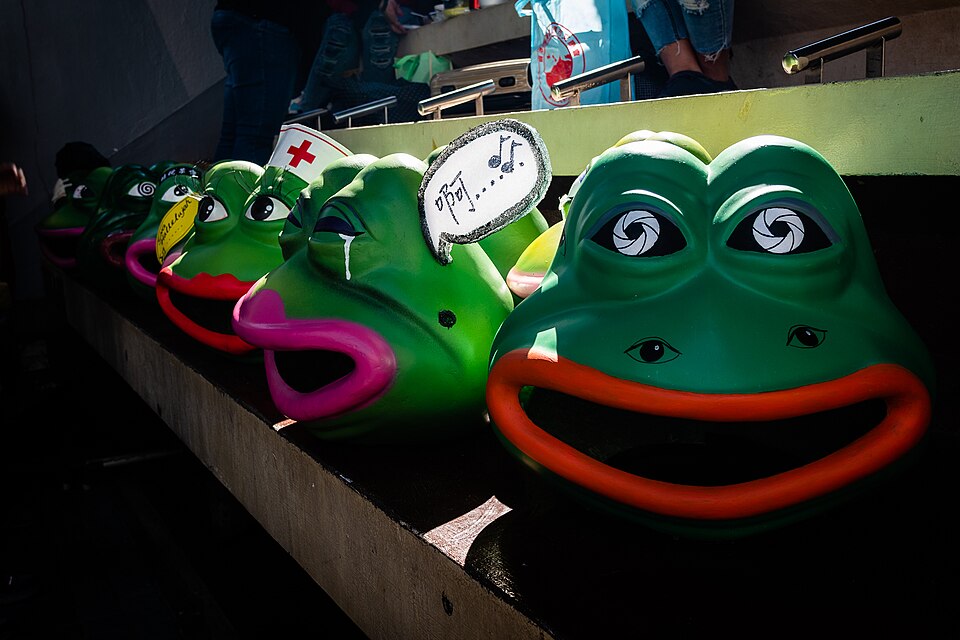
The frog, remarkably, was saved — just not by Kekistan. Three forces did the work. Matt Furie's long counter-campaign — lawsuits, #SavePepe, the documentary Feels Good Man — reasserted authorship. The Hong Kong democracy protests of 2019 adopted Pepe as a symbol of resistance, entirely innocent of the American culture war, and scrambled the hate-symbol reading worldwide. And the Rare Pepe canon (Chapter XI) gave the frog a prestige history: proto-NFT, Sotheby's lot, museum piece of crypto culture. Today Pepe's default meaning on most of the internet is once again what it was in 2010 — a feeling, not an affiliation.
What the Cult Left
The Cult of Kek's deepest legacy is conceptual: it is the internet's canonical case study in irony as a delivery mechanism. The mechanism this book has traced — sincerity hidden inside a joke, the joke providing cover, the cover eventually becoming unnecessary — is now standard vocabulary among researchers of online extremism, and "irony poisoning" entered the language largely to describe what happened to the Republic's citizens. Every subsequent wave of masked-sincerity content on the internet gets analyzed with tools first sharpened on Kekistan. The satire of identity politics ended up producing, instead, the reference example of how identity forms online: give an anonymous crowd a name, a flag, a grievance, and an enemy, and watch the joke's quotation marks evaporate.
And the meme-magic doctrine — posting as a way of bending reality — no longer needs the god. The GameStop squeeze, the memecoin casino, a billionaire moving nine figures with a username: the twenty-first-century internet takes it as given that concentrated collective attention is a physical force. /pol/ called it Kek. Finance calls it sentiment. It is the same discovery.
Out of the darkness, light. Out of the memes, history.The creed, one last time
The Successors
Kekistan's political energy did not vanish; it re-branded. The clearest heirs:
- Honkler and "Clown World" (2019). Pepe in a rainbow wig and clown nose, born on /pol/ in February 2019 with the slogan "honk honk" and the clown-and-globe emoji as shorthand for civilizational absurdism. The ADL added "Honk Honkler" to its hate-symbol database that year — the Pepe cycle repeating almost beat for beat. "Clown world" survives as mainstream slang.
- Apu Apustaja, the counter-current. A childlike, badly-drawn Pepe descendant from Finland's Ylilauta board (early 2016), speaking broken English and calling everyone "fren." Apu powered the deliberately wholesome "frenworld" scene — itself later scrutinized for coded content — and, inevitably, a memecoin. Proof that even the gentle branch of the family tree could not escape either suspicion or monetization.
- The Groypers. Named for a chin-resting Pepe variant, the "Groyper Army" around Nick Fuentes became the institutional continuation of meme-native far-right politics: the 2019 "Groyper Wars" ambushing mainstream conservative campus events, renewed scrutiny after the September 2025 assassination of Charlie Kirk, and an October 2025 Tucker Carlson interview with Fuentes that split the American right over whether the meme fringe should be mainstreamed. The pipeline this book documents — from anonymous posting to real-world politics — did not close when Kekistan died; it professionalized.
The Country Itself
And Kekistan? It persists in exactly the places you would expect a fictional country to retire to. A micronation page on MicroWiki. A moribund subreddit under a green banner. Anthem uploads still gathering comments — "shadilay, brothers" — like flowers left at a monument. Novelty passports from a 2018 auction (five hundred were issued, for 20,000 PepeCash) now traded as memorabilia. A handful of dead tokens bearing its name — until, as Chapter 3.5 records, the name found a new body.
It is a strange epitaph: the imaginary nation failed at everything it claimed — no land, no census recognition, no lasting movement — and succeeded at the one thing no one planned. It became a complete, perfectly documented parable. In one decade, a single syllable of gamer laughter acquired a god, a prophet, an anthem, a flag, a president, a war, a fall, a ledger, and a treasury — and then dissolved back into laughter, leaving behind the entire story you have just read.
And yet the story refused to stay finished. In 2026 the Republic was refounded — new seal, new map, new treasury — and that revival is the subject of the next chapter. The appendices follow after: a master timeline of every date in this history, and a glossary of the Republic's tongue.
References
- Chatham House — The evolution of the Pepe meme (incl. Hong Kong)
- OILab — The Rise and Fall of Kekistan
- Feels Good Man (dir. Arthur Jones, 2020)
- Book of Kek — wiki.pepe.wtf, the Rare Pepe community's own history
- ADL — Honk Honkler; Wikipedia — Groypers; Know Your Meme — Apu Apustaja, monkaS