
The Green Frog
Pepe was drawn as a laid-back amphibian in a slacker comic about four roommates. He became the most contested cartoon character on Earth — and, to the cult, the living avatar of a god.
No god walks the earth without a body, and the god of Kekistan wore a face borrowed — some would say stolen — from a gentle San Francisco cartoonist named Matt Furie. This chapter is the story of the host: Pepe the Frog, from his first appearance in 2005 to the moment the Cult of Kek declared him divine.
Feels Good Man
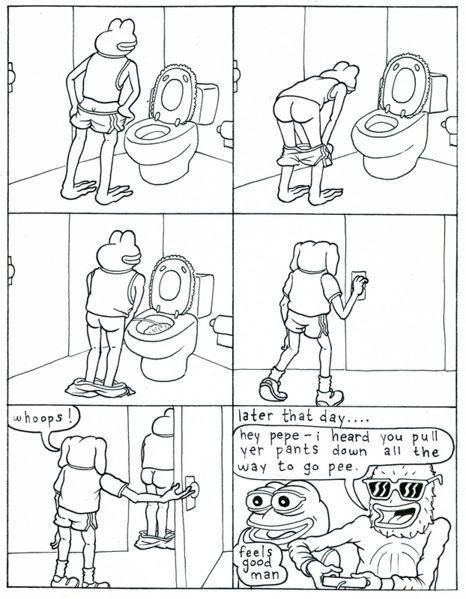
In 2005, Furie began publishing Boy's Club, a stoner-slacker comic about four anthropomorphic roommates: Brett, Andy, Landwolf, and a frog named Pepe. The strip that changed everything was almost aggressively trivial. Pepe is caught urinating with his pants pulled all the way down to his ankles. Asked why, he answers with the line that became his creed:
Feels good man.Pepe the Frog, Boy's Club (Matt Furie, 2005)
The panel escaped its comic. It surfaced on Myspace, spread through bodybuilding forums, and by around 2008 had colonized 4chan, where Pepe stopped being a character and became a vocabulary. Users redrew him into every emotional register the boards required: Feels Good Man for triumph, Sad Frog ("feels bad man") for despair, Smug Frog for superiority, Angry Pepe for rage. He became the shared face of a faceless community — the emotional alphabet of the anonymous internet.
Rare Pepes
By 2014, an economy had formed around the frog. Users began producing elaborate, one-off Pepe illustrations, stamping them with watermarks like "RARE PEPE — DO NOT SAVE," and jokingly trading them as scarce collectibles. Collections of "rare Pepes" were listed on eBay and traded in threads like contraband art. It was a parody of the art market conducted entirely in cartoon frogs — and, as we'll see in Chapter XI, it turned out to be a rehearsal for the invention of the NFT.
Pepe's reach peaked as pop culture: Katy Perry and Nicki Minaj both posted Pepe memes to millions of followers in 2014–15. For a moment, the frog belonged to everyone.
The Capture
That moment ended in late 2015. Partly in reaction to the frog's mainstream adoption — normies were "stealing" their mascot — users on 4chan's /pol/ board began deliberately fusing Pepe with extremist imagery: Hitler mustaches, swastikas, uniforms. The point, at first, was repulsion: make the frog toxic and the tourists would drop him. But the campaign coincided with /pol/'s embrace of Donald Trump's candidacy, and the two projects merged. Trump-as-Pepe images multiplied; on October 13, 2015, Trump's own account tweeted one, which the board received as an anointing.
The escalation had real-world consequences:
- Sep 12, 2016The Clinton campaign publishes an explainer formally condemning Pepe as a symbol associated with white supremacy — instantly the most surreal artifact of the election, and to 4chan, a trophy: a presidential campaign had acknowledged the frog.
- Late Sep 2016The Anti-Defamation League adds Pepe to its Hate Symbols Database — while carefully noting that most Pepe memes are not bigoted, and later supporting reclamation efforts.
The Avatar
It was against this backdrop that the Kek revelation of November 2015 (Chapter II) did its work. The Cult of Kek supplied the final transformation in Pepe's strange career: from character, to meme, to symbol, to icon in the religious sense of the word. Pepe, the cult declared, was the modern avatar of Kek — the form the frog-headed god of primordial darkness takes to move through the internet.
The pieces were assembling. The word (Chapter I) supplied the holy name. The god (Chapter II) supplied the theology. The frog supplied the face. What the religion still lacked was a mechanism of worship — a sacrament. It found one in the most unlikely place imaginable: the sequential post numbers of an anonymous message board.
References
- Fast Company — The twisted history of Pepe the Frog
- BBC (Sep 2016) — Pepe the Frog labelled a hate symbol
- BBC (May 2017) — Pepe the Frog "killed off" by creator
- Chatham House — The evolution of the Pepe the Frog meme
- Documentary — Feels Good Man (dir. Arthur Jones, 2020)