The Word
Before the nation, before the god, before the frog — there was a word. It was born in a Korean arcade, baptized in an Orcish tongue, and crowned with a Turkish snack cake.
Every nation begins with a language, and Kekistan — a country with no land, no borders, and no citizens who exist on paper — began with a single word. To understand how millions of people came to type kek instead of "lol," you have to travel back to the PC bangs of late-1990s South Korea, where the strangest etymology in internet history begins.
Kekeke: The Laughter of the Zerg
In Korean, typed laughter is rendered ㅋㅋㅋ — the character ㅋ representing a raspy "k" sound, a stifled snicker rather than a belly laugh. When Blizzard's StarCraft (1998) became a national obsession in South Korea, its chat system couldn't display Hangul. Korean players improvised, romanizing their laughter as kekeke.
For Western players on Battle.net, the sound became infamous. It was the last thing you read before your base was overrun — the taunt that traditionally accompanied a Zergling rush. kekeke ^_^ was not friendly laughter. It was the laughter of someone who had just destroyed you, and it burned itself into gamer memory as shorthand for gloating, mischievous glee.
The Orcish Translation
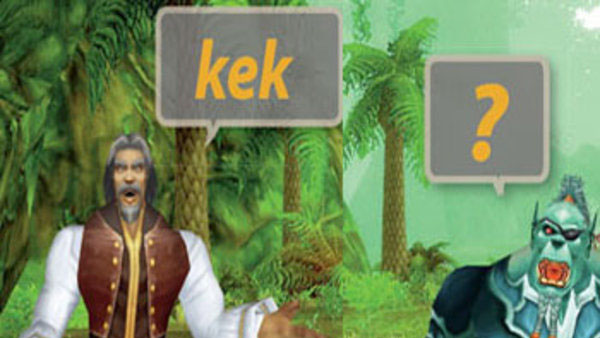
On November 23, 2004, World of Warcraft launched — and with it, the accident of language that made "kek" immortal. Blizzard had built a cipher into the game: text typed by Horde players appears to Alliance players as garbled pseudo-Orcish, and vice versa, so the factions cannot coordinate. Under this cipher, when a Horde player types lol, an Alliance player sees:
kekThe Orcish cipher, World of Warcraft, 2004
Players immediately recognized it as Blizzard's nod to the StarCraft kekeke tradition. And so "kek" crossed over: no longer just Korean laughter, but "lol" in Orcish — laughter wearing a mask, laughter in translation. On March 22, 2005, an Urban Dictionary user named "drat" submitted the first definition, four words long: "'lol' in Orcish." By 2007 forum threads were explaining the mechanic; by 2011 the slang dictionaries had it catalogued.
There is something almost too fitting in this origin. The word that would one day name a god of hidden things and a nation of anonymous posters was itself born as encrypted laughter — a joke that only reads as a joke once you know the code.
Top Kek: The Cake of Destiny
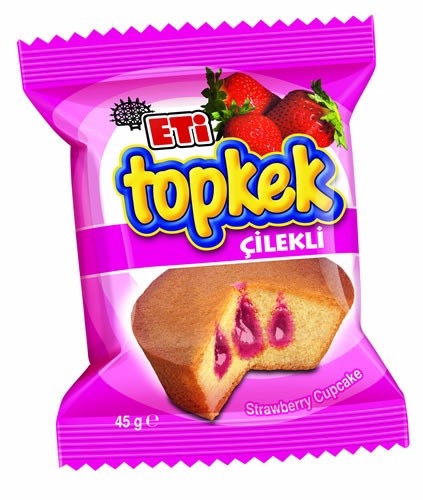
The word might have remained gamer slang forever if not for a coincidence of global commerce. "Kek," it turns out, is also the Turkish word for cake — and since 1990, the Turkish food company Eti has produced a line of small packaged snack cakes called Topkek.
When photos of Topkek packaging reached 4chan, the pun was irresistible. Fused with the existing ironic superlative "top lel," the phrase top kek came to mean supreme laughter — the highest possible rating a joke could receive. On May 13, 2013, a user posting as "prime minister face" started a Topkek appreciation thread on 4chan's /s4s/ board that drew over six thousand replies. An Urban Dictionary entry followed that September.
By the middle of the decade, "kek" had effectively replaced "lol" across 4chan. And this mattered more than it might seem: the word had become a shibboleth. Typing "lol" marked you as a visitor, a normie, a tourist. Typing "kek" marked you as a native. A community that prized anonymity above all had found a way to recognize its own — not by name, but by dialect.
So by 2015 the stage was set. A word meaning laughter in disguise, spoken by a tribe of the anonymous. A green frog (whom we shall meet in Chapter III) serving as that tribe's shared face. All that was missing was a theology to bind them together.
It arrived, as revelations tend to, from the distant past — four and a half thousand years in the past, on the banks of the Nile.
References
- Know Your Meme — Kek, Topkek
- Warcraft Wiki — Kek (Orcish cipher)
- Urban Dictionary — kek (first entry, March 22, 2005)
- Wiktionary — kek, top kek