
The God of Darkness
In late 2015, 4chan discovered that "kek" was already the name of a real ancient Egyptian deity — a frog-headed god of the darkness before the first dawn. The coincidence became a theology.
On November 27, 2015, a post appeared on 4chan's history board, /his/. It carried an image of an ancient Egyptian deity: a man with the head of a frog. His name, the poster explained, was Kek. What happened next is the closest thing internet culture has to a religious revelation — the moment a decade-old in-joke collided with genuine Egyptology and produced a theology.
The Real Kek: Egyptology, Briefly
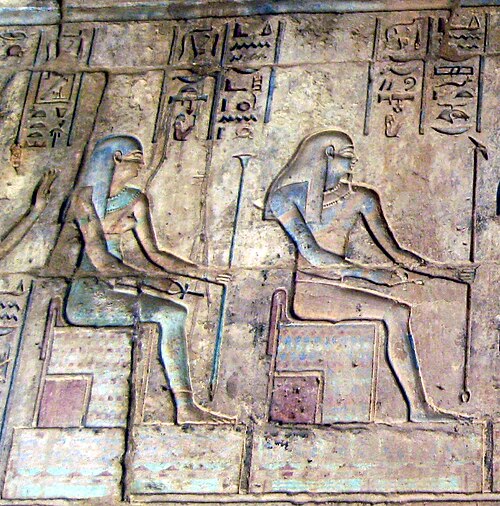
Strip away the memes, and the god is real — or at least, really ancient. Kek (Egyptian kk, also rendered Kuk or Keku, written with signs associated with kkw, "darkness") was the deification of primordial darkness in the creation system of Hermopolis, in Middle Egypt.
In this cosmology, before the world existed there was only the pre-creation state, personified by eight primeval deities — the Ogdoad — arranged in four male–female pairs:
- Nun and Naunet — the primal waters
- Heh and Hauhet — endlessness
- Kek and Kauket — darkness
- Amun and Amaunet — hiddenness
The males of the Ogdoad were depicted with the heads of frogs; the females with the heads of serpents. In the Greco-Roman period, Kek's standard depiction settled into the form that would electrify a message board two millennia later: a frog-headed man.
And here is the detail on which the entire mythology of Kekistan turns. Kek was not simply darkness as void or evil. As the darkness that existed before the first sunrise, he carried a paradoxical epithet: "raiser up of the light." He was the chaos out of which the dawn is born — the darkness that necessarily precedes, and produces, illumination.
The Revelation of /his/
Now consider what this looked like from inside 4chan in late 2015. For ten years, the community had laughed in a borrowed word: kek. For seven years, its shared face had been a cartoon frog: Pepe. And now an anonymous historian arrives bearing news that in the beginning — the actual, cosmological beginning — there was a god:
- whose name was Kek,
- who was depicted as a frog-headed man,
- who ruled darkness and chaos,
- and whose office was to bring forth light from that darkness.
To a community that half-ironically believed its collective posting could alter reality, this did not read as coincidence. It read as retroactive prophecy. They had not invented a frog god; they had, without knowing it, been chanting the name of one all along. The board's self-mythology wrote itself: we are the darkness the respectable world despises, and out of us comes the dawn.
Out of the darkness, light. Out of the memes, history.The creed of Kek, as the cult told it
A further layer circulated in screenshots that no Egyptologist would endorse but which the faithful adored: certain hieroglyphic renderings associated with the name were fancifully read as depicting a seated figure before a screen-like object — instantly dubbed the prophecy of the "divine keyboard." An ancient carving of a man at a computer, they joked. The god had foreseen the shitposter.
From Coincidence to Creed
What made the Kek revelation durable was that it retroactively organized everything the community already did into a liturgy. The word "kek" became a holy name. Pepe was declared the god's modern avatar — the form Kek takes to move through the internet. The random post numbers of 4chan (of which more in Chapter IV) became the medium of his blessings. Greetings changed: posts began and ended with "Praise Kek."
Within a year, this improvised faith would acquire an anthem recorded in 1986 by a band that happened to be named P.E.P.E., and within eighteen months, a nation — flag, president, and all. The darkness, as the epithet promised, was busily raising things up.
References
- Wikipedia — Kek (mythology) — the Ogdoad, epithets, and depictions
- Know Your Meme — Cult of Kek
- SPLC Hatewatch (May 9, 2017) — "What the Kek: Explaining the Alt-Right 'Deity' Behind Their 'Meme Magic'"