The Founding of Kekistan
A failed plan to buy a Caribbean island, a tweet about the British census, and forty-eight hours in which a joke became a nation.
Most countries are founded by war, migration, or treaty. Kekistan was founded by a tweet. But like most sudden births it had a long gestation — and its story begins, as so much of this history does, in an anonymous thread.
Prehistory: The Island That Never Was
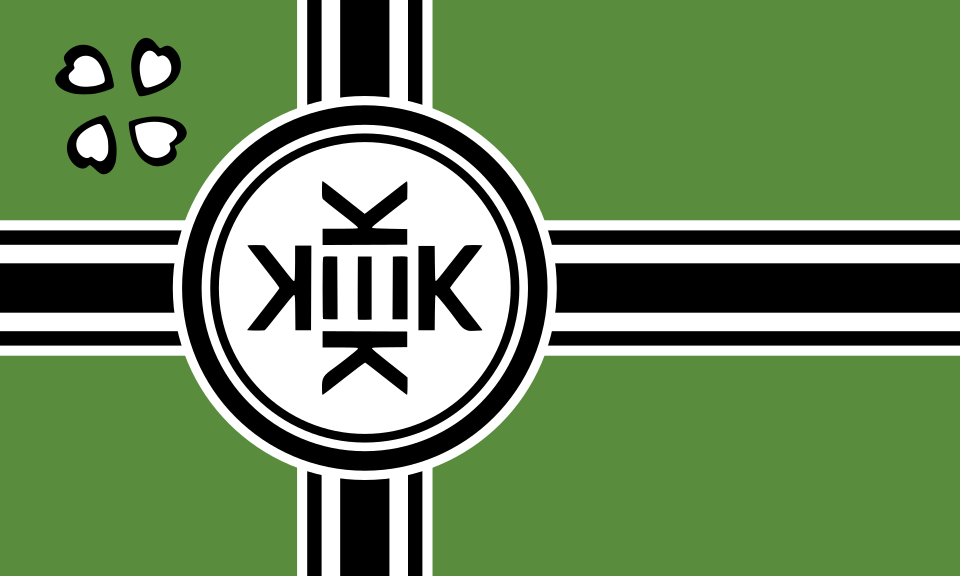
The name "Kekistan" is older than the nation. A flag image with the filename kekistan.jpg was posted to 4chan's international board /int/ as early as December 2015 — a joke country for the people of kek, floated and forgotten.
On December 14, 2016, a thread on /pol/ proposed something more ambitious: the board should pool its money and buy a Caribbean island, incorporating as an actual micronation. Names were debated; "Kekistan" kept winning. No island was ever purchased — of course it wasn't — but the thread did something more durable than real estate: it fixed the idea that the posters were a people, and that a people ought to have a homeland.
The Census Joke
The spark came six weeks later from outside 4chan. On January 30, 2017, the British YouTuber Carl Benjamin — known to his hundreds of thousands of subscribers as Sargon of Akkad — tweeted that "shitposters" met the British government's criteria for an ethnicity, and that he intended to register them as such on the census. He polled his followers on what the ethnicity should be called. The winner: Kekistani.
A disparate and dispossessed people.Carl Benjamin's description of the Kekistani "ethnicity," January 2017
Benjamin framed the bit explicitly as satire — in his telling, a "parody of identity politics… for people who don't like identity politics." The Kekistani people would perform every trope of the oppressed minority: an ancient homeland, a diaspora, a history of persecution (by "normies"), a demand for recognition and reparations. The joke, its architects said, was aimed at what they saw as the grievance culture of the identitarian left — and, some participants insisted, at neo-Nazis too. Fellow YouTuber Jeff Holiday described the intent as a parody state that "would take the piss" out of both.
Forty-Eight Hours
What happened next surprised even its instigator. Within roughly two days:
- Jan 30, 2017The tweet. Sargon proposes the Kekistani ethnicity; #FreeKekistan begins to trend.
- Jan 31, 2017The state apparatus assembles itself. A "Republic of Kekistan" Twitter account launches and passes 5,000 followers in its first days; Kekistan.com appears bearing a "Kek manifesto."
- Feb 1, 2017The institutions. The /r/kekistan subreddit organizes under the tagline "There is only one God (Kek) and Pepe is his prophet"; Encyclopedia Dramatica opens its Kekistan page the same day.
The speed is the story. Kekistan required no invention because every component already existed — the god (Chapter II), the avatar (Chapter III), the doctrine (Chapter IV), the anthem (Chapter V), even the flag, which had been circulating since late 2016. Benjamin didn't build the nation; he declared it, and a fully formed culture crystallized around the declaration overnight. Researchers at the University of Amsterdam's OILab, who later mapped Kekistan's rise and fall through YouTube's recommendation system, identified Benjamin as the crucial legitimizing figure: the bridge that carried an imageboard in-joke to mainstream YouTube audiences in February 2017.
The Satire and Its Shadow
From its first hours, Kekistan contained the contradiction that would eventually destroy it. Read one way, it was genuinely funny — a Borges-worthy conceit, a nation of the terminally online demanding UN recognition, conducted with the internet's characteristic manic thoroughness. Read another way, it was a flag-shaped loophole: a way to march, chant, and organize under far-right-adjacent iconography while insisting, with a straight face, that you were merely an oppressed Kekistani patriot.
But in February 2017, the fall was still unimaginable. Kekistan was ascendant — and a nation ascending needs symbols. A flag. An anthem. A president. The Republic acquired all three, and each one is a story.
References
- Know Your Meme — Kekistan
- OILab, Univ. of Amsterdam (April 2018) — The Rise and Fall of Kekistan
- Critical Muslim Studies — Kekistan, the alt-right and parody
- DigitalCultures — Kekistan