
Shadilay
In 1986, an Italian studio band called P.E.P.E. pressed a disco single with a frog on the label. Thirty years later, to the month, the internet found it — and declared it prophecy.
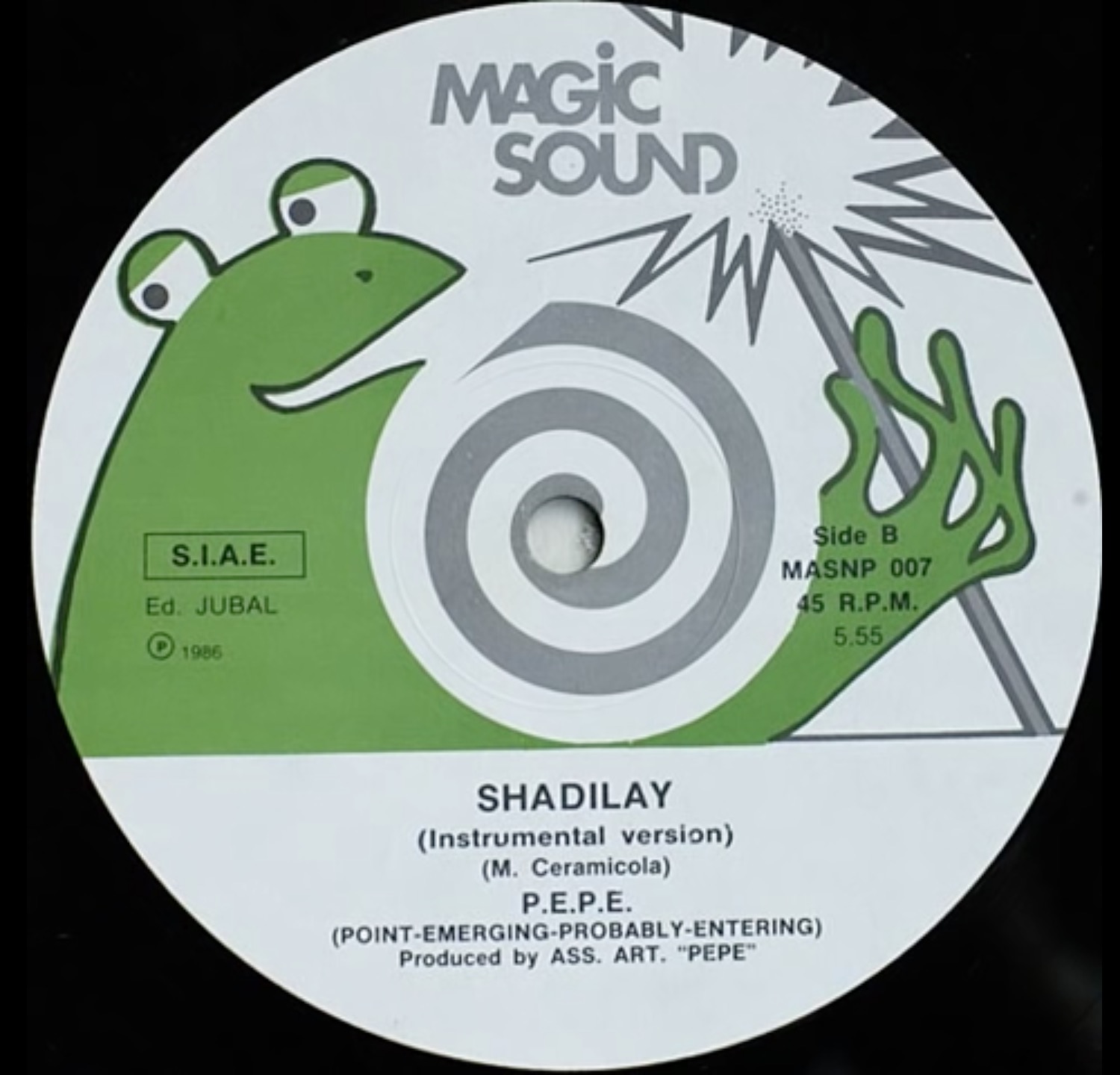
Of all the coincidences the Cult of Kek collected, none was stranger, more delightful, or harder to explain away than a twelve-inch italo-disco record pressed in Italy on March 3, 1986. If you set out to fabricate evidence that a frog god had been planning something for thirty years, you could not have done better than what the crate-diggers of /pol/ actually found.
The Record
"Shadilay" was released on the Italian label Magic Sound by a studio act billed as P.E.P.E. — a backronym for "Point Emerging Probably Entering." It was written and sung by Marco Ceramicola under the stage name Manuele Pepe, arranged by Massimo Marcolini, and built on the era's definitive synthesizer, the Yamaha DX7: 103 beats per minute, verses in A minor, choruses breaking into C major. A vocal side of 6:06, an instrumental on the flip.
And on the record's center label, Magic Sound printed its house artwork: a green cartoon frog holding a magic wand.
The single made no particular impression in 1986. It sold modestly and vanished into the vast catalogue of Italian dance music, where it slept for exactly thirty years.
The Discovery
In September 2016 — the very month Pepe the Frog was being condemned by a US presidential campaign and catalogued by the ADL — the record surfaced on 4chan. On September 13, 2016, a YouTube channel reposted the track under the title "/pol/ exclusive – P.E.P.E. - Shadilay." The board was electrified. Consider the inventory, as the faithful tallied it:
- A band literally named P.E.P.E.
- On a label called Magic Sound — meme magic, on the tin
- Bearing the image of a green frog with a magic wand
- Released in 1986 — thirty years before the ascension of the "God-Emperor," and, the numerologists noted, echoing the sacred digits
To a community that had spent a year assembling a theology out of coincidences, this was the capstone — received not as a curiosity but as archaeological proof of the Prophecy of Kek. Within days an essay circulating under the title "The Truth About Pepe the Frog and the Cult of Kek" anointed the song as Kek's official hymn. Remixes flooded YouTube and SoundCloud: orchestral versions, "patriotic" versions, military-parade versions, eventually racking up millions of plays under titles like "National Anthem of Kekistan."
What "Shadilay" Means
The delicious anticlimax at the center of the legend: the word "shadilay" means nothing. It is an invented coinage, chosen for how it sings. But a religion built from repurposed materials had no trouble repurposing one more: by October 2016 the faithful had defined it as an all-purpose greeting, exclamation, and benediction — "amen," "hallelujah," and "hello, brother" rolled into one word. In early 2017 the song was formally adopted as the national anthem of the newly proclaimed Republic of Kekistan (Chapter VI), and Shadilay! became the standard greeting between self-declared Kekistanis, shouted at rallies and typed in a hundred thousand comment sections.
By the start of 2017, the assembly was complete. A word ten years sacred. A god four millennia old. An avatar with a green face. A doctrine of digits and magic. And now a national anthem, pressed on vinyl before most of the faithful were born.
Book I of this history ends here, because what happened next changed the register entirely. The cult stopped being a religion and declared itself a country.
References
- Wikipedia — Shadilay
- Discogs — P.E.P.E. – Shadilay (Magic Sound, 1986)
- Know Your Meme — Shadilay
- YouTube — Ceramicola performs Shadilay on Italian TV