
The Ledger of Rare Things
In September 2016, an anonymous user minted a Pepe trading card onto the Bitcoin blockchain — and accidentally invented the NFT. The joke about rarity became rarity itself.
While the Republic was assembling its flags, a parallel civilization of the frog was building something with a far longer half-life. It began, like everything in this book, as a joke — "rare Pepes," hoarded like contraband — and ended with a cartoon frog hammering for $3.65 million at Sotheby's. This is the chapter where the meme becomes money, and where the joke about artificial scarcity turns out to be a rehearsal for an entire industry.
The Joke About Scarcity
Recall from Chapter III: by 2014–15, users were watermarking one-off Pepe illustrations "RARE PEPE — DO NOT SAVE" and pretending to trade them as collectibles. In April 2015 an eBay auction of a rare Pepe collection reached a top bid of $99,166 before eBay pulled the listing. The bit was a parody of the art market: what could be more absurd than scarcity in a medium defined by infinite copying?
Then someone made the scarcity real.
Genesis Block
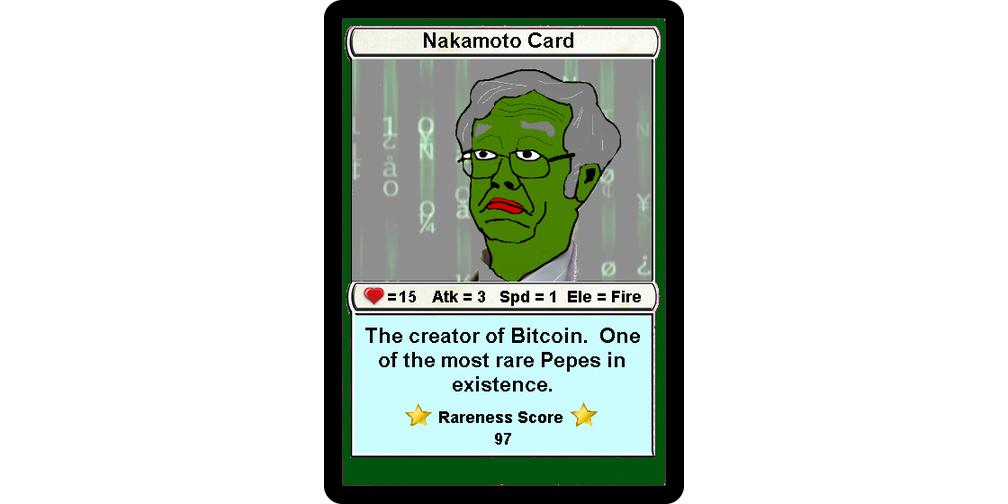
In September 2016, an anonymous user known only as "Mike" minted the first Rare Pepe trading cards as tokens on Counterparty, a protocol layered on the Bitcoin blockchain. The genesis card — RAREPEPE, Series 1, Card 1, depicting Satoshi Nakamoto as Pepe — was written into Bitcoin block 428,919. For the first time, a meme image carried an integrated, transferable, immutable certificate of authenticity. The word "NFT" did not yet exist. The thing itself now did.
A Boston developer named Joe Looney built the Rare Pepe Wallet, a web interface that let non-technical users create, buy, sell, gift, and destroy Rare Pepes — functionally an NFT marketplace, years early. And around the project grew an institution that may be this history's finest invention: the Rare Pepe Scientists, anonymous curators who certified submissions at rarepepedirectory.com under the standard that each card be "original, humane, and dank."
If a Pepe isn't listed on the directory, it isn't Certified Rare.The Rare Pepe Directory's iron law
The rules were exacting: 400×560 pixel cards, locked issuance between 100 and 100,000 units, Pepe-relevance mandatory, a 200 PEPECASH submission fee — burned if you plagiarized. "Humane" was a real criterion: the scientists' standard quietly excluded the hate-symbol lineage, and the scene's culture was crypto-libertarian and absurdist rather than /pol/-political. From 2016 to 2018, the community certified exactly 1,774 cards across 36 series before rising Bitcoin fees closed the directory — a complete, finite corpus, like a dead language with a perfect dictionary.
PepeCash and the Economy of Dank
PEPECASH — Series 1, Card 2, one billion units — became the ecosystem's currency, trading against cards on Counterparty's built-in exchange. Valuation followed a three-factor model the community recited with a straight face: age, rarity, and dankness — the last defined as memetic power, an asset class no other market has ever priced directly.
Homer, Sotheby's, and the Vindication
The scene's rise from in-joke to art history is best told through its auction record:
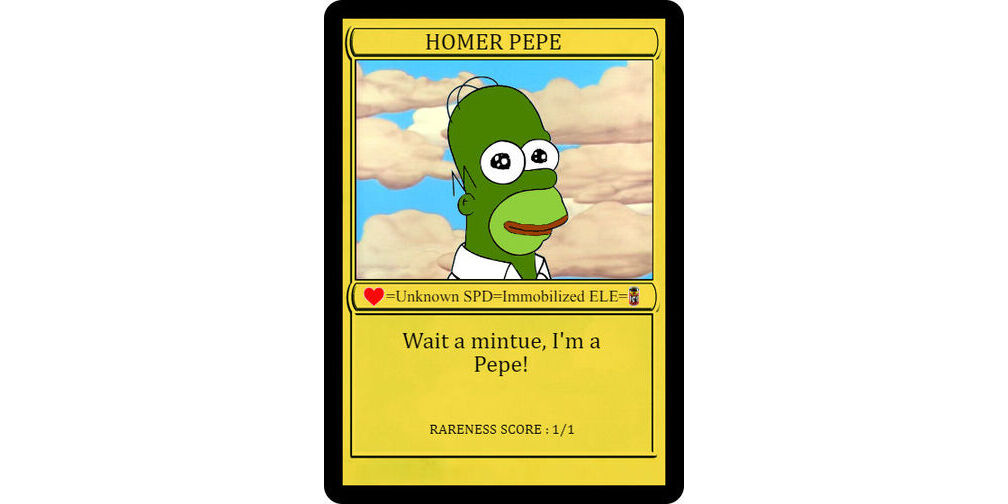
- Jan 13, 2018The Rare AF festival, New York. Collector Peter Kell wins HOMERPEPE — a one-of-one Homer Simpson Pepe — for 350,000 PepeCash, roughly $38,500: a record for crypto art at the time, and headline proof that the "joke" market was real.
- Sep 2020Emblem Vault opens the bridge, letting Counterparty-era cards be wrapped in Ethereum tokens and traded on OpenSea — carrying the 2016 artifacts into the coming NFT mania.
- Mar 2021Homer returns. Kell resells HOMERPEPE for 205 ETH — about $320,000 — to the collector TokenAngels, who sold CryptoPunks to fund the purchase.
- Sep 10, 2021A genesis RAREPEPE (Nakamoto card) sells for ~$500,000 on OpenSea via Emblem Vault.
- Oct 26, 2021Sotheby's. At "Natively Digital 1.2," PEPENOPOULOS — a one-of-one Pepe of Bitcoin educator Andreas Antonopoulos — hammers at $3,650,000, the record for any Counterparty asset. The same sale moves a Nakamoto card for $239,400. Five years after "do not save," a rare Pepe hangs, in effect, in the world's oldest auction house.
- Jan 20, 2024The market persists: a Series 1, Card 1 RAREPEPE sells for 67 ETH (~$166,660) via the Bitcoin auction house Scarce City.
Schisms and Successors
Like any scripture, the completed directory bred heresies. In September 2021 the artist Rare Scrilla, banned from the Rare Pepe Telegram for sharing a card rejected in 2018, founded the Fake Rares — a rival directory whose genesis card, FREEDOMKEK, was literally his "Proof of Ban." The scene, styling itself "La Faka Nostra," spawned Dank Rares and Fake Commons in turn. And in 2021 Matt Furie himself finally entered the canon, minting FEELSGOODMAN as Series 20, Card 50 — after which Joe Looney pronounced the Rare Pepe Directory complete. (Furie's own NFT ventures promptly generated the scene's biggest scandal: a collector paid ~$537,000 for the card at auction in October 2021, whereupon Furie's PegzDAO released 46 free copies, cratering its value and drawing a half-million-dollar lawsuit. Even the reclamation had a fall.)
The ledger, however, was only the respectable half of the afterlife. The other half was louder, dumber, and vastly richer: the coins. Kekistan never had a treasury while it lived — but in death, tokens bearing its name and its god's would move nine-figure sums on the strength of a billionaire changing his username.
References
- Right Click Save — A Brief History of Rare Pepe
- Decrypt — How Rare Pepe NFTs Reclaimed Pepe the Frog
- Book of Kek — Famous Rare Pepe auctions; The Rare Pepe Directory
- Crypto Briefing — HOMERPEPE resale; Sotheby's Metaverse — PEPENOPOULOS result
- Vice — the PegzDAO lawsuit; Outland — Fake Rares origins