
The Green Candle
KekCoin's chain of memes, $PEPE's eleven-billion-dollar rise, and the night Elon Musk became Kekius Maximus — the Republic finds its treasury, years after its death.

Kekistan never minted a currency while it lived — a curious omission for a nation that worshipped GETs and green candles alike. The market corrected the oversight posthumously, and on a scale no citizen of the Republic could have imagined: by the mid-2020s, the iconography of kek was moving more money in an afternoon than most real small nations' GDP.
KekCoin: The Currency That Died With Its Country
The first attempt came at the meme's peak. KekCoin launched on July 17, 2017 — a proof-of-stake coin with a Bitcoin-homage supply of 21 million, announced on Bitcointalk and pitched squarely at the Republic: the cryptocurrency of Kekistan. Its one genuine idea was the MemeChain, which hashed memes into the blockchain to create "a cryptographically verifiable chain of memes" — timestamped, provable meme authorship, sold with the slogan:
Don't let your memes be dreams, let them remain forever entwined with the blockchain of Kek.KekCoin announcement, Bitcointalk, 2017
Its fate tracked its homeland's. KekCoin traded on minor venues of the kind that themselves died young — its main exchange, Cryptopia, was hacked in January 2019 and liquidated by May — and today the trackers show zero price, zero volume, no markets. A dead coin of a dead country. The later namesakes did no better: a procession of "Kekistan" tokens on Ethereum, BSC, and Solana (KEK, KEKI, "Republic of Kekistan," a squatter reviving the kekcoin.com name in 2023) came and went as micro-caps. The pattern is striking — every token named for Kekistan itself has failed. The money, like the culture, flowed to the frog instead.
$PEPE: The Eleven-Billion-Dollar Frog
On April 14, 2023, anonymous creators stealth-deployed $PEPE on Ethereum: no presale, zero taxes, liquidity burned, contract renounced, and a supply drawn straight from the numerology of the boards — 420,690,000,000,000 tokens. Its manifesto was pure kek-culture revanchism: "the most memeable memecoin in existence," tired of derivative dog coins — "the dogs have had their day" — with a roadmap of three phases: Meme; Vibe and HODL; Meme Takeover. (And, in small print, a disclaimer that has become the frog's economic signature: no association whatsoever with Matt Furie.)
It hit a $1.6 billion market cap within three weeks. In the 2024 cycle it went further than anyone thought a joke could go: an all-time high on December 9, 2024, with a market capitalization above $11 billion — briefly overtaking Uniswap's token to crack the top twenty crypto assets on Earth. The obligatory drama arrived on schedule: in August 2023, three ex-team members looted the project multisig of roughly $15 million in tokens and vanished, the remaining developer blaming "nefarious ex-team members"; an NFT provocateur's attempt to unmask the founder — as a 26-year-old Arizona photographer with an $865,000 Lamborghini and, pointedly, no payments to Furie — remains unconfirmed.
The peak did what peaks do: by late 2025 the token had drawn down roughly ninety percent, rallying briefly in January 2026 on a celebrity trader's "record 2026" call. But the stranger milestone was bureaucratic — Canary Capital filed for a spot $PEPE exchange-traded fund, putting the frog-god's iconography into SEC paperwork. A meme that began as a watermark joke about scarcity was now the underlying asset of a proposed Wall Street product.
Kekius Maximus: The God-Name Returns
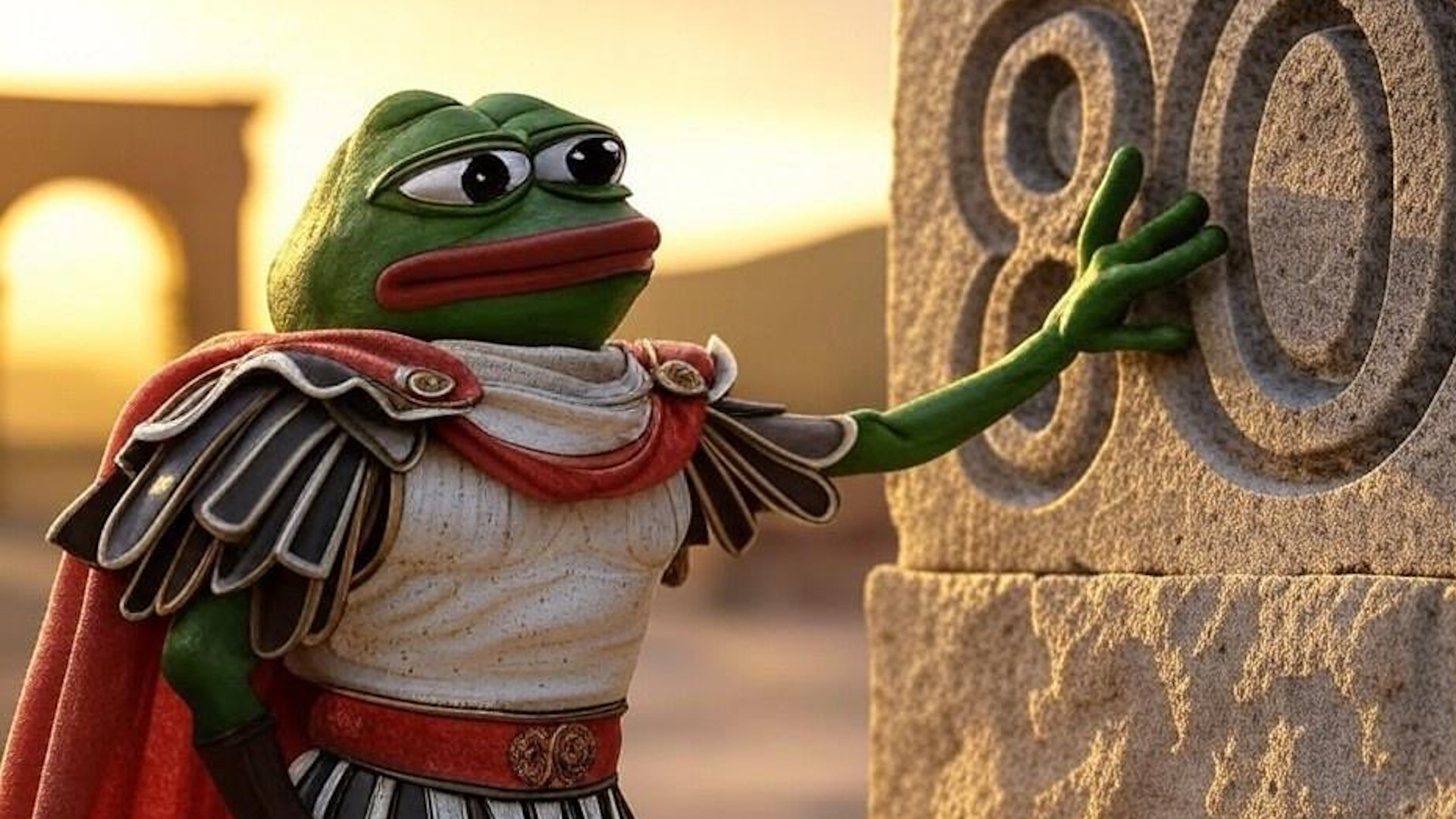
The strangest proof of kek's persistence came on New Year's Eve 2024, when Elon Musk — owner of X, then the world's richest man — renamed his account "Kekius Maximus" and set his avatar to Pepe as a Roman gladiator holding a game controller. A pre-existing micro-token of the same name detonated: reported gains ranged from twelve-fold to over two-hundred-fold within hours, with peak market cap estimates between $77 million and $343 million depending on the snapshot — "briefly into nine figures by some measures" is the safest wording. $PEPE itself rose seven percent on the name change alone.
When Musk reverted his name on January 1, 2025, the token crashed by more than half; one whale banked $2.3 million on the round trip. He revived the persona in mid-May 2025 and the token surged again — roughly 140% in a day this time — while copycats mushroomed. The episode requires no interpretation, which is what makes it remarkable: eight years after the Republic dissolved, a single invocation of the god's name by a sufficiently powerful account could still summon — and incinerate — hundreds of millions of dollars before breakfast.
The candle, green or red, always burns down. What's left when it does — for a word, a god, a frog, and a country that never was — is the subject of our final chapter.
References
- Bitcointalk — KekCoin announcement; CoinPaprika — KekCoin (dead)
- CoinMarketCap — PEPE; pepe.vip — manifesto; FXStreet — $11B cap
- The Block — the multisig theft
- Crypto Briefing — Kekius Maximus surge; Benzinga — the crash
- The Crypto Times — May 2025 Kekius revival