The Republic in the Streets
2017: the flag leaves the screen. From a stolen livestream banner in Tennessee to the rallies of Berkeley and Boston — the year Kekistan became physically real, and the year that reality began to indict it.
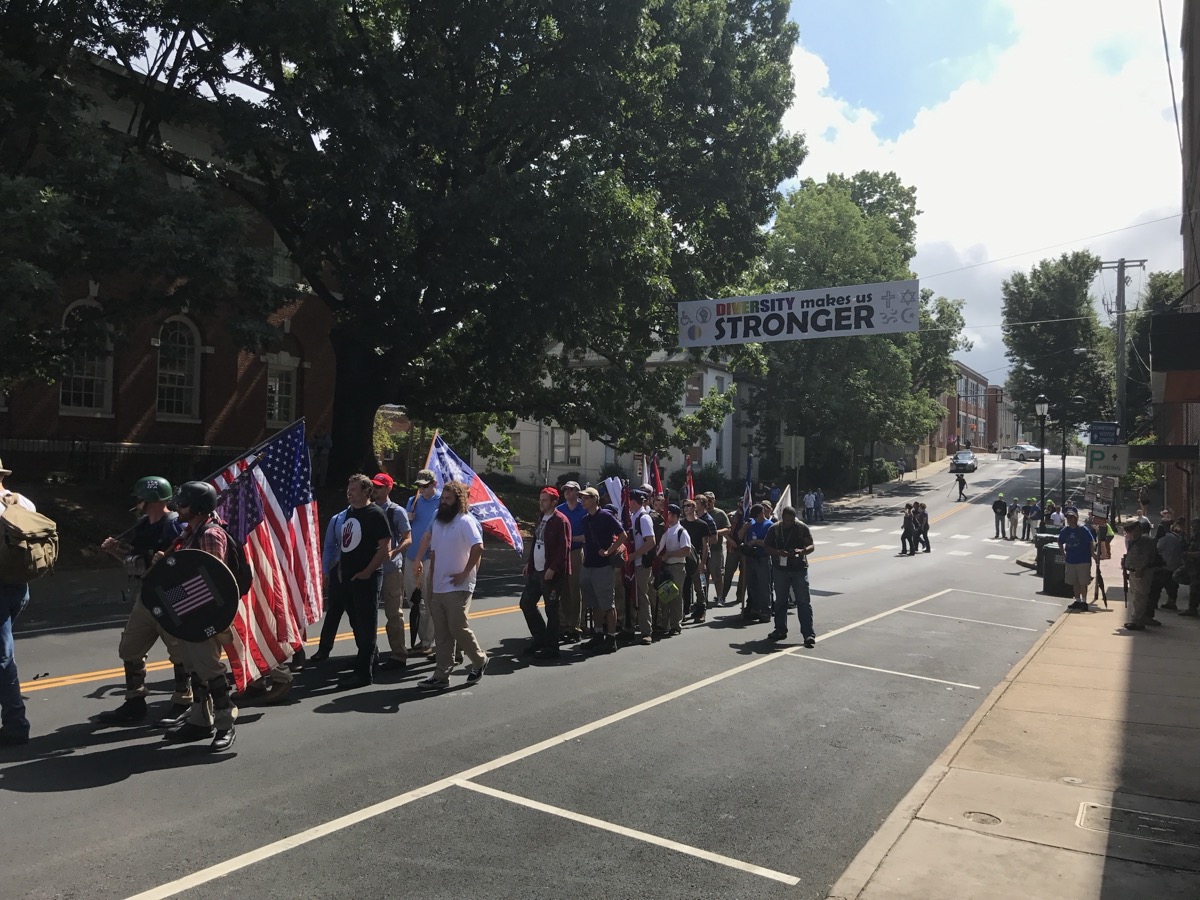
An imagined community becomes something else the day its members assemble in one place. For Kekistan that transformation came in 2017, and it happened with astonishing speed: within months of the founding tweet, the green banner was being carried down American streets. Each appearance made the joke more famous — and each one bound it more tightly to company that no satire could survive.
First Blood: The Flag of Greeneville
Kekistan's first physical conquest was, fittingly, a flag. In March 2017, Shia LaBeouf's anti-Trump art livestream "He Will Not Divide Us" — already chased out of two locations by trolls — retreated to its most abstract form yet: a white flag reading HE WILL NOT DIVIDE US, flying at a secret location, filmed against nothing but sky.
4chan treated the anonymous sky as a puzzle, and solved it in roughly thirty-seven hours. Users cross-referenced aircraft contrails against public flight paths, matched weather patterns, and confirmed the position — Greeneville, Tennessee — by star charts. A team drove out at night, lowered the flag, and hoisted a Pepe shirt and a MAGA cap in its place.
Flag captured. Praise Kek./pol/, March 10, 2017
The boards celebrated it as the definitive miracle of meme magic operating in physical space (Chapter IV), and Kekistani flags flew at, and over, subsequent installations of the livestream. The capture demonstrated something genuinely new and genuinely unsettling: the distributed forensic power of an anonymous crowd, aimed at a physical target, for a joke.
Berkeley: The Flag Finds a Crowd
On April 15, 2017, at the third in a series of violent "free speech" confrontations in Berkeley, California — remembered online as the "Battle of Berkeley" — Kekistan flags appeared prominently in the pro-Trump crowd. This was the banner's true public debut: photographed by news agencies, waved beside American and Gadsden flags, flown by young men performing the "oppressed Kekistani" bit for cameras (Chapter VIII).
The Southern Poverty Law Center, covering the rally, described a participant carrying "a flag modeled after flags produced by Hitler's Third Reich" — the mainstream's first widely read decoding of the banner's template. The deniability machine spun up in response: it's a joke about a fake country; why do you know so much about Nazi flags? Through the spring and summer the flag became a fixture of right-wing street events, and SPLC's May 9 "What the Kek" explainer — intended as an exposé — measurably amplified the meme it described.
Charlottesville: The Hinge
Then came August 11–12, 2017. At the Unite the Right rally in Charlottesville, Virginia — the largest open gathering of white nationalists in modern American history — Kekistan flags were carried alongside swastikas, Confederate battle flags, and the torches of the Friday night march. On MSNBC, anchor Ali Velshi stood before a graphic decoding the rally's symbols and told a national audience: "This is the Kekistani flag."
On August 12, a neo-Nazi drove his car into a crowd of counter-protesters, murdering Heather Heyer and injuring dozens. The green banner was in the photographs of the day's marches.
One week later, at the August 19 Boston "Free Speech Rally," the green flags appeared again — and this time the press coverage identified them on sight, without needing an explainer. The pattern was set. The flag's final major cameo came years after the Republic itself had dissolved: on January 6, 2021, a rioter carried a Kekistan flag in the mob that stormed the US Capitol, and the banner duly appeared in the symbol-decoders of Time, the Washington Post, and National Geographic — filed, without ambiguity, under the iconography of the far right.
The street era gave Kekistan its maximum fame and sealed its fate in the same gesture. By the autumn of 2017 the Republic was known to cable news audiences — and increasingly abandoned by the people who had built it as a joke. The fall had begun.
References
- TMZ (Mar 10, 2017) — the HWNDU flag capture; Vice — "heist of the century"
- SPLC — The Battle for Berkeley; Berkeleyside — rally photos
- Mediaite — Ali Velshi identifies the flag at Charlottesville; SPLC — Charlottesville flags guide
- Boston Magazine — Boston Free Speech Rally
- France 24 Observers / Time — Capitol riot symbol decoders, Time