The Fall
Narrative exhaustion, abandoned founders, a video game scrubbing the flag from its armor — and a joke that stopped being funny because it stopped being a joke.
Nations usually fall to armies or economics. Kekistan fell to something stranger: the collapse of its own irony. The Republic's entire existence depended on a suspended question — is this a joke? — and in August 2017 the question was answered in the streets of Charlottesville. What follows is the story of the eighteen months in which the imaginary nation dissolved.
Contamination
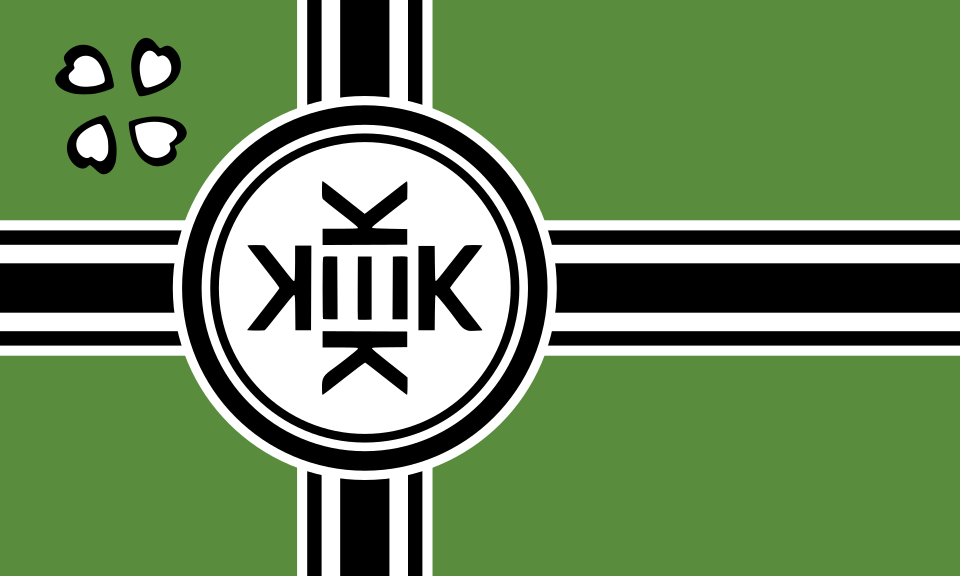
After Charlottesville, the flag was radioactive, and the world's institutions began treating it accordingly. The most literal example came from an unexpected quarter: a video game. On September 12, 2017 — one month after the rally — Bungie removed the "Road Complex AA1" gauntlets from Destiny 2 because the armor's green-and-K's motif "shares elements with a hate symbol." The company said the resemblance was unintentional, the design predating Kekistan itself, and later restored the armor with the marking scrubbed. The episode measured exactly how far the banner had fallen: a pattern of K's on green was now, by default, presumed to be hate iconography.
The commercial ecosystem came under fire next. Kekistan flags, shirts, and patches had sold briskly on Amazon — at one point the flag carried an "Amazon's Choice" badge — until a July 2018 letter from Rep. Keith Ellison to Jeff Bezos and subsequent advocacy reports flagged the merchandise as white-nationalist gear. Listings persisted despite removal claims, but the framing was settled: Kekistan merchandise was now catalogued alongside actual Nazi paraphernalia in reports about Amazon's moderation failures.
Exhaustion
Inside the culture, the joke was dying of more ordinary causes. Researchers at the University of Amsterdam's OILab, who traced Kekistan's arc through YouTube's recommendation system, mapped a textbook meme lifecycle: explosive growth (February 2017), peak visibility (May–July 2017, paradoxically boosted by the SPLC's exposé), then "narrative exhaustion" — the point at which a bit has no new places to go. After August 2017 the network fragmented, with the meme's remnants drifting into Spanish- and Russian-language gaming channels, increasingly detached from any political project. By 2018, self-aware "Kekistan is dead" videos were a genre of their own.
The founders walked away. Carl Benjamin's standing in his own community was damaged by a January 2018 livestream debate with the white nationalist Richard Spencer, widely scored as a loss — an encounter that made the distance between the "liberalist" satirists and the actual far right look thinner than advertised. Benjamin moved on to a Patreon ban (December 2018) and a UKIP candidacy (2019), and stopped promoting the bit entirely. The participants who had wanted Kekistan as anti-identity-politics parody complained bitterly that the alt-right had co-opted it — the sentiment behind a "Reclaim Kekistan" current that never revived anything. Big Man Tyrone resigned the presidency in an April Fools' Day video in 2019, citing death threats, its sincerity permanently uncertain (Chapter VII).
The alt-right co-opted it, much to the annoyance and chagrin of those who wish to keep it as a parody.Participant account of Kekistan's capture, 2017–18
The Grim Coda
By late 2018 the Republic existed mainly as a residue, and the residue kept surfacing in dark places. In November 2018, coverage of a fifteen-year-old Florida murder suspect noted the Kekistani flag displayed on his Facebook profile — the kind of detail that, by then, journalists knew how to read. The /r/kekistan subreddit drifted into inactivity, where it remains: a ghost town under a green banner. And on January 6, 2021, the flag made its final major appearance, carried into the mob at the US Capitol — a country that never existed, present at an attempt to overturn an election in one that does.
And yet the story does not end in the dark. While the Republic was collapsing in the streets, an entirely different lineage of the frog — older than Kekistan, and pointedly apolitical — was quietly building something on the Bitcoin blockchain that would outlast every flag. The afterlife of kek begins in a most unexpected place: a wallet full of trading cards.
References
- OILab (Apr 2018) — The Rise and Fall of Kekistan
- GamesRadar — Destiny 2 armor removal; Stevivor — restoration
- HuffPost (Aug 2018) — Amazon and Kekistan merchandise
- Wikipedia — Carl Benjamin; Know Your Meme — Kekistan